
- Home
- Company
- Services
- Articles
- Contact
- Home
- Company
- Services
- Articles
- Contact

Curriculum
- 6 Sections
- 20 Lessons
- Lifetime
Expand all sectionsCollapse all sections
- Module 1: Foundation & MindsetWelcome to Your Business Journey. Every morning, millions of South Africans wake up with purpose - serving their communities, creating jobs, and building wealth through small businesses that form the backbone of our economy. Whether you're taking your first entrepreneurial step or ready to transform your existing venture into something bigger, you're about to join a powerful movement of dreamers who became doers, and doers who became successful business owners.6
- 1.1Lesson 1.1: You Are a Businessperson
- 1.2Lesson 1.1 – Quiz – You Are a Businessperson8 Questions
- 1.3Lesson 1.2: Why Small Businesses Fail
- 1.4Lesson 1.2 – Quiz – Why small businesses fail22 Questions
- 1.5Lesson 1.3: What Are You Selling and Why
- 1.6Lesson 1.3: Quiz – What Are You Selling and Why?24 Questions
- Module 2: Understanding your MarketUnderstanding your market isn't just helpful - it's the difference between guessing and winning. When you know who buys from you, when they buy, and why they choose you over competitors, every business decision becomes smarter, from what to stock to when to open your doors.4
- Module 3: Planning & Financial ManagementRunning a business without a plan is like driving without a map. You waste time, you waste money, and you might never arrive. This fundamental truth separates successful businesses from those that struggle and eventually fail. Planning isn't just paperwork—it's the foundation that transforms chaotic daily activities into strategic actions that build wealth and success.10
- 3.1Lesson 3.1: Business Planning
- 3.2Lesson 3.1: Quiz – Business Planning26 Questions
- 3.3Lesson 3.2: Understanding Costs
- 3.4Lesson 3.2: Quiz – Understanding Costs10 Minutes15 Questions
- 3.5Lesson 3.3: Smart Stock Management
- 3.6Lesson 3.3: Quiz – Smart Stock Management15 Questions
- 3.7Lesson 3.4: Simple Record Keeping
- 3.8Lesson 3.4: Quiz – Simple Record Keeping15 Questions
- 3.9Lesson 3.5: Pricing Strategy
- 3.10Lesson 3.5: Quiz – Pricing Strategy15 Questions
- Module 4: Money ManagementIn South Africa, cash flow challenges are particularly acute for small businesses due to several unique factors: Extended payment terms: Many corporate clients expect 30-60 day payment terms, while your suppliers often require immediate payment - Economic volatility: Rand fluctuations and inflation affect purchasing power and costs - Seasonal business patterns: Tourism, agriculture, and retail sectors experience significant seasonal variations - Load shedding impact: Power cuts affect productivity and cash generation cycles - High unemployment: Affects customer spending patterns and payment reliability6
- Module 5: Resilience & GrowthIn South Africa, tough times aren't the exception - they're part of the business landscape. From load shedding to economic downturns, from seasonal slowdowns to global crises like COVID-19, resilient businesses are those that prepare for challenges before they arrive. The difference between businesses that survive and those that don't isn't luck - it's preparation.6
- Module 6: Building Your Brand & FutureYour brand is much more than just a name or logo - it's your business's personality, promise, and reputation all rolled into one. In South Africa's diverse and competitive marketplace, a strong brand can be the difference between blending into the crowd and standing out as the go-to choice in your community. Whether you're selling vetkoek at a taxi rank or running a consulting business from home, your brand is what people remember, talk about, and ultimately choose.8
- 6.1Lesson 6.1: Building Your Brand
- 6.2Lesson 6.1: Quiz – Building Your Brand12 Questions
- 6.3Lesson 6.2: Marketing on a Budget
- 6.4Lesson 6.2: Quiz – Marketing on a Budget12 Questions
- 6.5Lesson 6.3: Legal Basics – Getting Your Business Right with the Law
- 6.6Lesson 6.3: Quiz – Legal Basics12 Questions
- 6.7Lesson 6.4: Your Continuing Journey – Keep Learning, Growing, and Lifting Others
- 6.8Lesson 6.4: Quiz – Your Continuing Journey12 Questions
Lesson 3.3: Smart Stock Management
Learning Objectives
By the end of this lesson, you will be able to:
– Optimize inventory levels to match your cash flow and sales patterns
– Identify fast and slow-moving items to maximize profitability
– Plan for seasonal changes that affect what customers buy
– Make smart buying decisions that keep money flowing through your business
– Avoid common stock mistakes that trap your money in unsold goods
Introduction: Your Stock is Your Lifeline
In South Africa, many small businesses fail not because they can’t sell, but because their money is trapped in stock that won’t move. Whether you’re selling vegetables from a trolley, running a spaza shop, or operating a hair salon from home, understanding stock management can be the difference between success and failure.
This lesson will show you how to think about stock like a river – it must keep flowing. When stock stops moving, your business stops growing, and your money gets stuck where it can’t help you.
Video Content Overview
The Golden Rule: Stock is Money in a Different Shape
The video teaches a powerful truth: every item you buy transforms your cash into stock. That stock must transform back into cash (plus profit) as quickly as possible.
The longer stock sits, the more it costs you in:
– Storage space
– Risk of damage or theft
– Money you can’t use for other opportunities
– Stock going out of date or out of fashion
Buy Smart, Sell Fast Philosophy
This isn’t just about buying cheap:
– it’s about buying what your customers actually want, when they want it, in the right quantities.
Smart buying means:
– Understanding your customers’ patterns
– Knowing your area’s seasonal needs
– Buying quantities you can sell quickly
– Testing new items carefully before committing
Understanding Your Stock Categories
Fast Movers (Your Business Heroes)
These items sell quickly and regularly. In South African small businesses, common fast movers include:
For Street Vendors
– Everyday fruits (bananas, oranges, apples)
– Basic vegetables (onions, tomatoes, potatoes)
– Cigarettes (where legally sold)
– Airtime and data vouchers
– Cold drinks on hot days
For Spaza Shops
– Bread and milk
– Sugar, tea, coffee
– Soap and washing powder
– School snacks (sweets, chips)
– Basic medicines (panado, stomach tablets)
For Hair Salons
– Popular hair relaxer brands
– Basic shampoo and conditioner
– Hair ties and clips
– Edge control products
Characteristics of Fast Movers
– Sell within 1-3 days of stocking
– Customers ask for them regularly
– Low spoilage risk
– Consistent demand throughout the month
Slow Movers (The Profit Killers)
These items take weeks or months to sell, tying up your money:
Warning Signs
– Been in stock for over 2 weeks
– Only sell 1-2 per month
– Customers ask “what’s that?” instead of asking the price
– You bought them because they were “a good deal”
– Seasonal items bought at wrong time
Common Slow Movers
– Expensive items in cash-strapped areas
– Off-brand products customers don’t recognize
– Fashion items that went out of style
– Bulk packs when customers need singles
– Imported snacks nobody knows
Dead Stock (Your Money Prison)
Items that haven’t sold in over a month:
– Get rid of them immediately
– Sell at cost price or even at a loss
– Use them as “buy 2 get 1 free” promotions
– Learn from the mistake and don’t repeat it
The South African Selling Calendar
Month-End Patterns (25th-5th of each month)
What Sells More
– Groceries and food items
– Alcohol (where legally sold)
– Children’s school supplies
– Household necessities
– Clothing and personal items
What Sells Less
– Luxury items
– Non-essential goods
– Expensive repairs or services
Stock Management Strategy
– Stock up on essentials before 25th
– Reduce luxury items mid-month
– Plan cash flow around these cycles
School Calendar Impact
During School Terms
– School uniforms and shoes
– Stationery and books
– Lunch box snacks
– Transport money alternatives (like prepaid electricity)
School Holidays
– Children’s clothes and toys
– Entertainment items
– Family food (more meals at home)
– Less pressure on household budgets
Back-to-School (January)
– Huge demand for school supplies
– Families spending savings
– Opportunity for higher-margin items
– Plan and save for this peak season
Seasonal Patterns
Summer (October – March)
– Cold drinks and ice
– Fresh fruits
– Light clothing
– Sun protection products
– Increased foot traffic
Winter (April – September)
– Hot drinks and soup
– Warm clothing
– Flu and cold remedies
– Comfort foods
– Indoor entertainment
Rainy Season
– Umbrellas and raincoats
– Waterproof bags
– Hot food and drinks
– Less foot traffic – plan accordingly
Economic Calendar
Grant Payment Days (1st-2nd of month)
– Increased spending power
– Stock up on regular goods
– Opportunity to move slower items
Holiday Seasons
– Christmas: Major stocking opportunity but high competition
– Easter: Religious items, family goods
– Heritage Day: Traditional foods and cultural items
Smart Buying Strategies for Small Business
The 80/20 Stock Rule
80% Safe Bets: Items you know will sell
– Products you’ve sold successfully before
– Items customers ask for regularly
– Basic necessities that never go out of demand
20% Test Items: New products to try
– New flavors or brands
– Seasonal items
– Products other successful vendors are selling
– Items customers have requested
Quantity Planning Methods
The Week’s Sales Method
– Calculate how much of each item you sell per week
– Buy 1-2 weeks’ worth of fast movers
– Buy smaller quantities of slow movers
– Never buy more than you can sell in a month
Example: Thabo’s Spaza Shop Bread Ordering
– Sells 50 loaves per week on average
– Orders 60 loaves twice per week (Monday and Thursday)
– Reduces waste and ensures freshness
– Adjusts for month-end (70 loaves) and mid-month (40 loaves)
The Cash Flow Method
– Decide how much money you can afford to tie up in stock
– Allocate percentages: 60% fast movers, 30% medium movers, 10% test items
– Don’t spend more than 70% of your available cash on stock
– Keep 30% for unexpected opportunities and emergencies
Supplier Relationship Management
Building Good Supplier Relationships
For Market Vendors
– Visit the same stalls regularly
– Pay on time and in full
– Ask about seasonal availability
– Learn about quality indicators
– Negotiate bulk discounts carefully
For Wholesale Buyers
– Understand credit terms and use them wisely
– Learn delivery schedules
– Ask about slow-moving stock deals
– Build relationships with sales reps
– Understand return policies
Negotiation Strategies
What You Can Negotiate
– Bulk purchase discounts
– Payment terms (pay after you sell)
– Delivery costs and schedules
– Returns on damaged goods
– First access to popular items
What to Avoid
– Buying large quantities just for discounts
– Credit terms you can’t meet
– Exclusive deals that limit your options
– Suppliers who demand upfront payment for everything
Stock Control Systems Anyone Can Use
The Simple Notebook System
Daily Stock Check
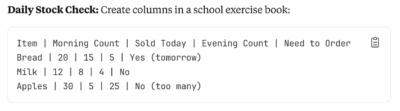
Weekly Review
– Which items sold out completely?
– Which items barely moved?
– What did customers ask for that you didn’t have?
– What patterns do you notice?
The Matchbox System for Very Small Businesses
For Street Vendors with Limited Stock
– Write each product on a piece of paper
– Use stones, bottle caps, or coins to count
– Move counters as you sell
– Simple but effective for 5-10 products
Using Your Cell Phone
Photos for Records
– Take pictures of your stock layout morning and evening
– Compare photos to see what moved
– Use voice notes to record what sold well
– Set phone reminders for restock days
Calculator Method
– Use calculator memory to track daily sales by item
– Reset each evening after recording in notebook
– Simple running totals for main products
The Family Helper System
Involving Family Members
– Children can help count stock after school
– Partners can track sales while you’re away
– Family members notice customer requests you might miss
– Share the workload and knowledge
Common Stock Management Mistakes in SA Small Business
Mistake 1: Buying Because It’s Cheap
The Trap:
“This supplier offered me 100 packets of biscuits at half price!”
The Problem:
– You don’t usually sell that many biscuits
– They expire before you can sell them
– Your money is stuck in slow-moving stock
– You miss opportunities to buy fast movers
The Solution:
– Only buy large quantities of proven fast movers
– Calculate how long it will take to sell before buying
– Remember: A good deal isn’t good if it doesn’t sell
Mistake 2: Copying Other People’s Stock Without Thinking
The Trap:
“That vendor down the road sells these imported sweets, so I should too.”
The Problem:
– Different locations have different customers
– They might have established relationships you don’t
– Their cost structure might be different
– You don’t understand the product’s seasonality
The Solution:
– Test new items in small quantities first
– Understand why something works for others
– Consider your unique customer base
– Start small and grow gradually
Mistake 3: Emotional Buying
The Trap:
“I love this new hair product, my customers will too!”
The Problem:
– Your taste might not match your customers’
– Personal preference doesn’t equal business success
– You might overspend on items you like but others don’t
– Emotional decisions ignore market reality
The Solution:
– Ask customers what they want before buying
– Test personal favorites in small quantities
– Separate personal preferences from business decisions
– Base decisions on sales data, not feelings
Mistake 4: Panic Buying
The Trap:
“School starts next week, I need to buy everything now!”
The Problem:
– Rushed decisions lead to overbuying
– You might choose wrong products under pressure
– Higher costs due to last-minute purchasing
– Cash flow problems from large sudden purchases
The Solution:
– Plan seasonal needs months in advance
– Build relationships with suppliers who can deliver quickly
– Keep emergency cash reserves for opportunities
– Create seasonal calendars to avoid surprises
Mistake 5: Not Adapting to Changes
The Trap:
“I’ve always sold these items, I’ll keep selling them.”
The Problem:
– Customer preferences change over time
– New competitors change the market
– Economic conditions affect buying patterns
– Technology makes some products obsolete
The Solution:
– Review stock performance monthly
– Listen to customer requests and complaints
– Watch what successful competitors are doing
– Be willing to drop items that no longer work
Advanced Stock Strategies
Product Mix Optimization
The Profit Pyramid Strategy
Base Level (60% of stock): High-volume, low-margin essentials
– Bread, milk, airtime
– Draw customers to your business
– Consistent sales but lower profit per item
Middle Level (30% of stock): Medium-volume, good-margin items
– Snacks, personal care items
– Balance between volume and profit
– Your main profit drivers
Top Level (10% of stock): Low-volume, high-margin specialties
– Premium products, hard-to-find items
– High profit per sale
– Attracts specific customer segments
Cross-Selling Opportunities
Natural Combinations:
– Bread and milk
– Tea and sugar
– School books and stationery
– Hair relaxer and conditioner
Seasonal Combinations:
– Umbrellas and raincoats (rainy season)
– Cold drinks and ice (summer)
– Soup and bread (winter)
– School uniforms and shoes (January)
Cash Flow Management Through Stock
The Rolling Stock System
Instead of buying a month’s worth of stock at once:
– Buy weekly quantities of fast movers
– Restock as items sell
– Use sales money to buy more stock immediately
– Keep cash flowing through the business
Example: Nomsa’s Fruit Stand
– Monday: Buy R200 worth of fruit
– Tuesday-Wednesday: Sell and earn R300
– Thursday: Use R200 to restock, keep R100 profit
– Repeat cycle, growing stock and profit gradually
Emergency Stock Planning
Always Keep Cash for:
– Unexpected opportunities (special deals)
– Seasonal rush periods (back-to-school, Christmas)
– Stock replacement (theft, damage, spoilage)
– New customer requests
The 70/30 Rule:
– Never tie up more than 70% of available cash in stock
– Keep 30% liquid for opportunities and emergencies
– Better to miss some sales than run out of cash completely
Technology Solutions for Stock Management
Free Mobile Apps
Calculator Apps with Memory
– Track daily sales by product category
– Running totals for popular items
– Quick calculations for reorder quantities
Note-Taking Apps
– Customer requests you can’t fulfill
– Supplier contact information
– Seasonal patterns you notice
– Stock ideas and observations
Camera for Documentation
– Before and after photos of stock displays
– Photos of successful competitor layouts
– Pictures of new products to research
– Visual records of seasonal changes
WhatsApp Business Features
Customer Communications
– Let customers know when new stock arrives
– Send photos of available items
– Take orders before restocking
– Build customer relationships
Supplier Communications
– Quick orders via voice messages
– Photo confirmations of stock quality
– Price updates and special offers
– Delivery coordination
Family/Partner Coordination
– Share daily stock updates
– Coordinate buying trips
– Alert about stock running low
– Share customer feedback
Banking Apps for Stock Planning
Track Stock Investment
– Monitor how much money is tied up in inventory
– Calculate stock turnover rates
– Plan cash flow for restocking
– Set aside money for seasonal purchases
Payment Planning
– Schedule supplier payments
– Track credit terms
– Monitor cash available for stock purchases
– Avoid overspending on inventory
Seasonal Stock Management Deep Dive
December Holiday Strategy
High-Demand Items:
– Party supplies and decorations
– Gift items at various price points
– Holiday food specialties
– Children’s toys and clothes
– Celebration drinks (where legal)
Planning Timeline:
– October: Research and plan holiday stock
– November: Start building holiday inventory
– Early December: Peak stocking period
– Late December: Focus on clearance and turnover
Cash Flow Management:
– Save money throughout year for holiday buying
– Higher investment but higher returns
– Plan for January cash flow gap
– Clear holiday stock before New Year
Back-to-School January Rush
Essential Items:
– School uniforms (various sizes)
– Stationery supplies
– School bags and lunch boxes
– Study materials
– Basic school shoes
Sizing and Quantity Strategy:
– Research local school requirements
– Stock multiple sizes of uniforms
– Partner with other vendors for complete solutions
– Offer layaway/credit for trusted customers
Timing Considerations:
– Start stocking in November/December
– Peak sales: mid-January to early February
– Clear remaining stock with discounts
– Use profits to fund normal operations
Winter Adaptation (April-September)
Product Adjustments:
– Hot drinks and soup ingredients
– Warm clothing items
– Cold and flu remedies
– Comfort foods
– Indoor entertainment
Customer Behavior Changes:
– Less foot traffic on cold days
– Preference for warm, comforting products
– Higher value per transaction
– More time-sensitive shopping
Operational Changes:
– Adjust opening hours for daylight
– Plan for heating costs
– Stock warmth-related products
– Consider delivery services
Drought and Economic Stress Periods
Survival Product Focus
– Basic food necessities
– Water storage containers
– Energy-saving devices
– Cheaper alternatives to popular products
– Bulk pack options for better value
Pricing Strategies
– Smaller pack sizes for affordability
– Credit options for regular customers
– Focus on essential rather than luxury items
– Community-oriented solutions
Location-Specific Stock Strategies
Rural Area Considerations
Unique Challenges:
– Limited supplier access
– Seasonal farming income patterns
– Traditional preferences
– Limited storage facilities
Stock Adaptations:
– Higher quantities due to infrequent restocking
– Focus on non-perishable items
– Traditional and cultural products
– Agricultural season-based planning
Township Business Stock Management
Customer Characteristics:
– Month-end spending patterns
– Walking-distance shopping
– Price-sensitive buyers
– Community-oriented purchasing
Stock Strategies:
– Small pack sizes for affordability
– Credit systems for regular customers
– Community event-related items
– Local preference products
Urban Street Vendor Approach
High Competition Factors:
– Many similar vendors nearby
– Fast customer turnover
– Space limitations
– Regulatory considerations
Differentiation Through Stock:
– Unique or hard-to-find items
– Superior quality products
– Convenient packaging
– Seasonal specialization
Suburban Home Business Stock
Customer Expectations:
– Higher quality products
– Convenience and service
– Seasonal variety
– Professional presentation
Inventory Considerations:
– Quality over quantity
– Seasonal rotation
– Special occasion items
– Value-added services
Building Stock Intelligence Networks
Customer Feedback Systems
Simple Ways to Gather Intelligence
– Ask customers what they’re looking for
– Notice what people ask for repeatedly
– Listen to complaints about current stock
– Watch what attracts browsers vs. buyers
Formal Feedback Methods
– Simple suggestion box
– Weekly customer conversations
– Family member observations
– Competitor watching
Supplier Intelligence
Learning from Suppliers
– What’s selling well for other customers?
– Seasonal trends they’re seeing
– New products coming to market
– Economic factors affecting supply
Building Information Networks
– Regular communication with sales reps
– Relationships with other business owners
– Industry news and updates
– Government policy changes
Community Stock Intelligence
Vendor Networks
– Share information about customer trends
– Coordinate to avoid oversupply
– Learn from each other’s mistakes
– Joint purchasing for better prices
Customer Community Understanding
– Local events and celebrations
– Economic changes in the area
– Demographic shifts
– Cultural preferences and changes
Stock Security and Loss Prevention
Physical Security
Common Loss Sources
– Theft by customers or employees
– Damage during transport
– Spoilage due to poor storage
– Loss during load shedding
Prevention Strategies
– Proper storage containers and locks
– Insurance for valuable stock
– Secure transport arrangements
– Backup power for refrigerated items
Financial Security
Cash Flow Protection
– Never put all money into stock
– Diversify suppliers to reduce risk
– Keep receipts and records
– Track stock movement daily
Insurance Considerations
– Get stock insurance where available
– Understand what’s covered and what isn’t
– Factor insurance costs into pricing
– Consider self-insurance through cash reserves
Measuring Stock Management Success
Key Performance Indicators (KPIs)
Stock Turnover Rate
Simple Calculation
Monthly Sales ÷ Average Stock Value = Turnover Rate
– Higher numbers mean stock moves faster
– Aim for 4-8 times per month depending on business type
– Track by product category for insights
Days Sales Outstanding (DSO)
Simple Calculation
Average Stock Value ÷ Daily Sales = Days Stock Outstanding
– Lower numbers mean faster turnover
– Aim for 3-7 days for most small businesses
– Identifies slow-moving categories
Monthly Stock Review Questions
Performance Questions:
1. Which items sold out completely?
2. Which items barely moved?
3. What did customers ask for that I didn’t have?
4. What surprised me this month?
5. Where did I make my best profits?
Planning Questions:
1. What should I buy more of?
2. What should I buy less of?
3. What new items should I test?
4. How can I improve my buying process?
5. What seasonal changes should I prepare for?
Success Metrics
Cash Flow Indicators
– Money tied up in stock decreasing
– Faster conversion from stock to cash
– More cash available for opportunities
– Reduced need for credit or borrowing
Customer Satisfaction Indicators
– Fewer requests for out-of-stock items
– Customers finding what they need
– Positive comments about product selection
– Repeat customers increasing
Crisis Stock Management
Load Shedding Adaptations
Refrigerated Stock Challenges
– Cold drinks and dairy spoilage
– Ice cream and frozen goods losses
– Medicine storage requirements
– Customer preference changes
Adaptation Strategies
– Reduce refrigerated stock during high load shedding periods
– Invest in battery backup for essential refrigeration
– Focus on non-refrigerated alternatives
– Plan stock levels around load shedding schedules
Economic Downturn Stock Adjustments
Customer Behavior Changes
– Shift to cheaper alternatives
– Bulk buying to save money
– Delayed purchases of non-essentials
– Increased price sensitivity
Stock Response
– Increase basic necessities
– Reduce luxury items
– Offer smaller pack sizes
– Focus on value products
Supply Chain Disruptions
Common Disruptions
– Transport strikes
– Border delays for imports
– Supplier business failures
– Natural disasters
Preparation Strategies
– Diversify supplier base
– Build relationships with multiple sources
– Keep emergency stock of essentials
– Create alternative product plans
x

Contact With Us!
2220 Plymouth Rd #302, Hopkins, Minnesota(MN), 55305
Call us: (234) 109-6666
Mon – Sat: 8.00am – 18.00pm / Holiday : Closed