
- Home
- Company
- Services
- Articles
- Contact
- Home
- Company
- Services
- Articles
- Contact

Curriculum
- 6 Sections
- 20 Lessons
- Lifetime
Expand all sectionsCollapse all sections
- Module 1: Foundation & MindsetWelcome to Your Business Journey. Every morning, millions of South Africans wake up with purpose - serving their communities, creating jobs, and building wealth through small businesses that form the backbone of our economy. Whether you're taking your first entrepreneurial step or ready to transform your existing venture into something bigger, you're about to join a powerful movement of dreamers who became doers, and doers who became successful business owners.6
- 1.1Lesson 1.1: You Are a Businessperson
- 1.2Lesson 1.1 – Quiz – You Are a Businessperson8 Questions
- 1.3Lesson 1.2: Why Small Businesses Fail
- 1.4Lesson 1.2 – Quiz – Why small businesses fail22 Questions
- 1.5Lesson 1.3: What Are You Selling and Why
- 1.6Lesson 1.3: Quiz – What Are You Selling and Why?24 Questions
- Module 2: Understanding your MarketUnderstanding your market isn't just helpful - it's the difference between guessing and winning. When you know who buys from you, when they buy, and why they choose you over competitors, every business decision becomes smarter, from what to stock to when to open your doors.4
- Module 3: Planning & Financial ManagementRunning a business without a plan is like driving without a map. You waste time, you waste money, and you might never arrive. This fundamental truth separates successful businesses from those that struggle and eventually fail. Planning isn't just paperwork—it's the foundation that transforms chaotic daily activities into strategic actions that build wealth and success.10
- 3.1Lesson 3.1: Business Planning
- 3.2Lesson 3.1: Quiz – Business Planning26 Questions
- 3.3Lesson 3.2: Understanding Costs
- 3.4Lesson 3.2: Quiz – Understanding Costs10 Minutes15 Questions
- 3.5Lesson 3.3: Smart Stock Management
- 3.6Lesson 3.3: Quiz – Smart Stock Management15 Questions
- 3.7Lesson 3.4: Simple Record Keeping
- 3.8Lesson 3.4: Quiz – Simple Record Keeping15 Questions
- 3.9Lesson 3.5: Pricing Strategy
- 3.10Lesson 3.5: Quiz – Pricing Strategy15 Questions
- Module 4: Money ManagementIn South Africa, cash flow challenges are particularly acute for small businesses due to several unique factors: Extended payment terms: Many corporate clients expect 30-60 day payment terms, while your suppliers often require immediate payment - Economic volatility: Rand fluctuations and inflation affect purchasing power and costs - Seasonal business patterns: Tourism, agriculture, and retail sectors experience significant seasonal variations - Load shedding impact: Power cuts affect productivity and cash generation cycles - High unemployment: Affects customer spending patterns and payment reliability6
- Module 5: Resilience & GrowthIn South Africa, tough times aren't the exception - they're part of the business landscape. From load shedding to economic downturns, from seasonal slowdowns to global crises like COVID-19, resilient businesses are those that prepare for challenges before they arrive. The difference between businesses that survive and those that don't isn't luck - it's preparation.6
- Module 6: Building Your Brand & FutureYour brand is much more than just a name or logo - it's your business's personality, promise, and reputation all rolled into one. In South Africa's diverse and competitive marketplace, a strong brand can be the difference between blending into the crowd and standing out as the go-to choice in your community. Whether you're selling vetkoek at a taxi rank or running a consulting business from home, your brand is what people remember, talk about, and ultimately choose.8
- 6.1Lesson 6.1: Building Your Brand
- 6.2Lesson 6.1: Quiz – Building Your Brand12 Questions
- 6.3Lesson 6.2: Marketing on a Budget
- 6.4Lesson 6.2: Quiz – Marketing on a Budget12 Questions
- 6.5Lesson 6.3: Legal Basics – Getting Your Business Right with the Law
- 6.6Lesson 6.3: Quiz – Legal Basics12 Questions
- 6.7Lesson 6.4: Your Continuing Journey – Keep Learning, Growing, and Lifting Others
- 6.8Lesson 6.4: Quiz – Your Continuing Journey12 Questions
Lesson 3.4: Simple Record Keeping
Learning Objectives
By the end of this lesson, you will be able to:
– Set up basic business records using simple, affordable tools
– Track daily sales and expenses without expensive software
– Use your records to make smart business decisions
– Spot problems early before they damage your business
– Create a system that works even with limited education or resources
Introduction: Your Business Memory
In South African townships and informal settlements, many successful business owners can tell you exactly how much they made yesterday, but ask them about last month and they struggle. Without records, your business runs on memory alone – and memory fails when you need it most.
This lesson will show you how to create a simple record-keeping system that fits in your pocket, costs less than R20 to set up, and gives you the power to make decisions based on facts, not guesswork.
Video Content Overview
The Golden Rule: What Gets Written Gets Managed
The video teaches a fundamental business truth: if you don’t write it down, you can’t control it. This applies to every cent that comes into your business and every cent that goes out. Whether you’re selling vetkoek on the street or running a hair salon from home, the principle is the same.
One Page, One Day Philosophy
The video emphasizes keeping it simple: one page per day with everything written down. This isn’t about creating complicated systems – it’s about creating a habit of recording what matters most to your business survival.
If It’s Not Written, It Didn’t Happen
This might sound harsh, but it’s true for business purposes. That R50 sale you made but didn’t write down? For planning purposes, it didn’t happen. That R20 you spent on transport? If it’s not recorded, you’ll forget to include it in your costs and your profit calculations will be wrong.
Why Records Matter in Small Business
The Reality of Memory vs. Records
What People Remember
– Big sales that made them happy
– Major expenses that hurt
– Recent events (yesterday, this morning)
– Unusual or emotional transactions
What People Forget
– Small daily expenses that add up
– Quiet days with low sales
– Exactly how much was spent where
– Patterns and trends over time
The Cost of Poor Memory
– Mandla thought he was making R200 profit per day
– When he started writing everything down, his real profit was only R85 per day
– He was spending R115 more than he realized on small costs
– Without records, he would have continued losing money
Legal and Practical Benefits
Government Requirements
– Even informal businesses benefit from basic records
– Helps when applying for business licenses
– Required for bank account applications
– Needed for microfinance loan applications
Personal Benefits
– Know exactly how much you’re making
– Spot stealing or dishonest employees
– Plan for slow periods and busy seasons
– Make pricing decisions based on facts
– Prove income for rental applications or credit
Family Benefits
– Show your family the business is real and profitable
– Plan household budgets based on actual business income
– Separate business money from personal money clearly
– Leave a record if someone else needs to run the business
The R20 Record-Keeping System
What You Need (Total Cost Under R20)
Essential Items
– 1 school exercise book (48 pages) R8
– 1 pen that writes well R5
– 1 small ruler R3
– 1 pencil for corrections R2
– Total R18
Optional Extras
– Plastic sleeve to protect book R5
– Small calculator R15
– Rubber bands to keep book closed R2
What You Need (Total Cost Under R20)
Essential Items
– 1 school exercise book (48 pages) R8
– 1 pen that writes well R5
– 1 small ruler R3
– 1 pencil for corrections R2
– Total R18
Optional Extras
– Plastic sleeve to protect book R5
– Small calculator R15
– Rubber bands to keep book closed R2
Setting Up Your Daily Page
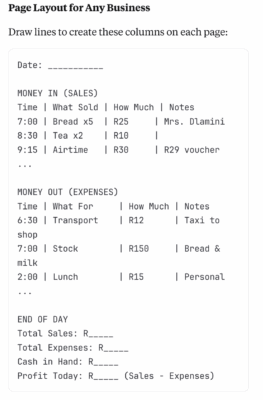
Page Layout for Any Business
Draw lines to create these columns on each page
—
Date ___________
MONEY IN (SALES)
Time | What Sold | How Much | Notes
700 | Bread x5 | R25 | Mrs. Dlamini
830 | Tea x2 | R10 |
915 | Airtime | R30 | R29 voucher
…
MONEY OUT (EXPENSES)
Time | What For | How Much | Notes
630 | Transport | R12 | Taxi to shop
700 | Stock | R150 | Bread & milk
200 | Lunch | R15 | Personal
…
END OF DAY
Total Sales R_____
Total Expenses R_____
Cash in Hand R_____
Profit Today R_____ (Sales – Expenses)
—
Daily Recording Habits
Morning Setup (5 minutes)
– Write today’s date at top of new page
– Count money in hand and write it down
– Set up your columns
– Review yesterday’s page quickly
During the Day (30 seconds per transaction)
– Write every sale immediately
– Write every expense immediately
– Use simple descriptions
– Don’t worry about perfect handwriting
Evening Review (10 minutes)
– Add up all sales for the day
– Add up all expenses for the day
– Count actual cash in hand
– Calculate profit (sales minus expenses)
– Note any differences or problems
Record-Keeping for Different Business Types
Street Vendor Records
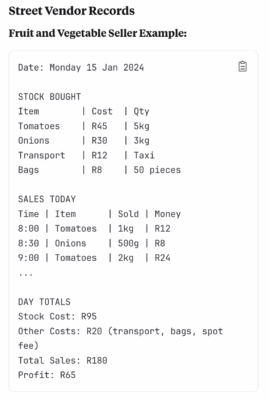
Fruit and Vegetable Seller Example
—
Date Monday 15 Jan 2024
STOCK BOUGHT
Item | Cost | Qty
Tomatoes | R45 | 5kg
Onions | R30 | 3kg
Transport | R12 | Taxi
Bags | R8 | 50 pieces
SALES TODAY
Time | Item | Sold | Money
800 | Tomatoes | 1kg | R12
830 | Onions | 500g | R8
900 | Tomatoes | 2kg | R24
…
DAY TOTALS
Stock Cost R95
Other Costs R20 (transport, bags, spot fee)
Total Sales R180
Profit R65
—
Spaza Shop Records
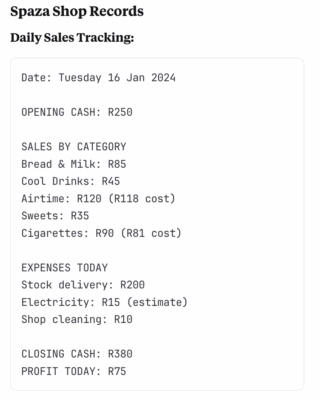
Daily Sales Tracking
—
Date Tuesday 16 Jan 2024
OPENING CASH R250
SALES BY CATEGORY
Bread & Milk R85
Cool Drinks R45
Airtime R120 (R118 cost)
Sweets R35
Cigarettes R90 (R81 cost)
EXPENSES TODAY
Stock delivery R200
Electricity R15 (estimate)
Shop cleaning R10
CLOSING CASH R380
PROFIT TODAY R75
—
Home-Based Business Records
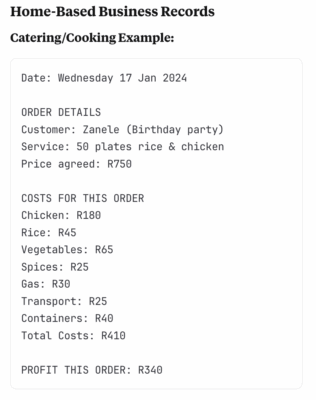
Catering/Cooking Example
—
Date Wednesday 17 Jan 2024
ORDER DETAILS
Customer Zanele (Birthday party)
Service 50 plates rice & chicken
Price agreed R750
COSTS FOR THIS ORDER
Chicken R180
Rice R45
Vegetables R65
Spices R25
Gas R30
Transport R25
Containers R40
Total Costs R410
PROFIT THIS ORDER R340
—
Weekly and Monthly Summaries
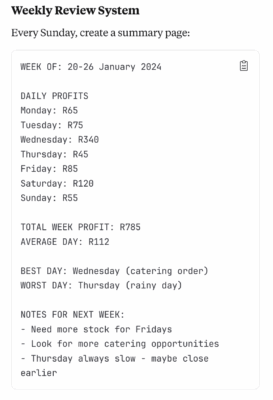
Weekly Review System
Every Sunday, create a summary page
—
WEEK OF 20-26 January 2024
DAILY PROFITS
Monday R65
Tuesday R75
Wednesday R340
Thursday R45
Friday R85
Saturday R120
Sunday R55
TOTAL WEEK PROFIT R785
AVERAGE DAY R112
BEST DAY: Wednesday (catering order)
WORST DAY: Thursday (rainy day)
NOTES FOR NEXT WEEK
– Need more stock for Fridays
– Look for more catering opportunities
– Thursday always slow – maybe close earlier
—
Monthly Business Health Check
At month end, answer these questions using your records
Income Questions
– What was my total income this month?
– Which days/products made the most money?
– What patterns do I see in my sales?
– How does this compare to last month?
Expense Questions
– What were my total expenses?
– Where did most of my money go?
– What unexpected costs came up?
– Which expenses can I reduce?
Profit Questions
– What was my real profit after all costs?
– Is this enough for my family’s needs?
– Am I making more or less than before?
– What do I need to change?
Using Records to Spot Problems Early
Theft Detection
Signs in Your Records
– Cash doesn’t match sales recorded
– Stock disappearing faster than sales show
– Consistent shortfalls on certain days
– Family members can’t explain differences
Example Sipho’s Spaza Shop
– Records showed R150 daily sales average
– Cash in till only R120 average
– Problem appeared on days when nephew helped
– Confronted issue early before major losses
Using Your Cell Phone
Photos for Records
– Take pictures of your stock layout morning and evening
– Compare photos to see what moved
– Use voice notes to record what sold well
– Set phone reminders for restock days
Calculator Method
– Use calculator memory to track daily sales by item
– Reset each evening after recording in notebook
– Simple running totals for main products
Waste and Spoilage Tracking
What to Record
– Products that expired or went bad
– Items damaged during transport
– Stock that got wet or dirty
– Quantities that had to be thrown away
Using This Information
– Buy smaller quantities of perishables
– Improve storage methods
– Choose different suppliers
– Adjust pricing to cover waste costs
Seasonal Pattern Recognition
What Your Records Will Show
– Which months are best for business
– What products sell more in winter vs. summer
– How school holidays affect sales
– Month-end vs. mid-month patterns
Business Decisions This Enables
– Save money during good months for slow periods
– Stock appropriate products for seasons
– Plan family budget around business cycles
– Time major purchases and investments
Price Problem Detection
Warning Signs in Records
– Working more but profit staying same
– Costs rising but sales not increasing proportionally
– Customers buying less of certain items
– Competitors taking customers
Solutions Based on Records
– Increase prices gradually
– Focus on higher-margin products
– Reduce costs where possible
– Find new customer segments
Technology Integration for Records
Using Your Cell Phone
Photo Backup System
– Take daily photos of your written records
– Store photos in phone gallery with dates
– Share with family member for safekeeping
– Easy to reference when away from book
Voice Recording for Illiterate Users
– Record daily sales totals as voice notes
– Use voice-to-text features where available
– Family member can help convert to written records later
– Captures information even if writing is difficult
Simple Calculator Integration
– Use phone calculator for daily totals
– Screenshot results and save with date
– Keep running totals for week/month
– Cross-check written records for accuracy
WhatsApp Business Records
Customer Order Tracking
– Screenshot orders received via WhatsApp
– Keep record of customer payments
– Track repeat customers and preferences
– Build customer database over time
Supplier Communication Records
– Keep WhatsApp conversations with suppliers
– Screenshots of price lists and deals
– Records of delivery confirmations
– Payment proof and receipts
Banking App Integration
Transaction Verification
– Check bank deposits against recorded sales
– Verify business expenses from bank statements
– Track electronic payments (EFT, card)
– Reconcile cash vs. electronic transactions
Cash Flow Planning
– Use records to predict bank balance needs
– Plan for large supplier payments
– Track business vs. personal money flows
– Build credit history with consistent deposits
Record-Keeping for Illiterate Business Owners
Symbol and Picture Systems
Product Symbols
Instead of writing “bread,” draw
– Simple bread loaf shape
– Stick figure symbols for different products
– Tally marks for quantities
– Simple pictures anyone can understand
Number-Only Systems
– Focus on amounts rather than descriptions
– Use columns for different product categories
– Family member helps with written descriptions weekly
– Pictures on phone supplement number records
Family Support Systems
Involving Literate Family Members
– Children help write up daily records after school
– Spouse handles weekly summaries
– Older family members provide guidance
– Shared responsibility builds business knowledge
Community Support
– Neighbor who can write helps with setup
– Local teacher provides basic training
– Community savings group shares knowledge
– Peer learning among business owners
Common Record-Keeping Mistakes and Solutions
Mistake 1 Making It Too Complicated
The Problem
“I tried to track everything – every onion, every tomato, every customer’s name and address…”
The Solution
– Start simple with just totals
– Add detail gradually as habit forms
– Focus on money in and money out first
– Perfect system is the one you actually use
Mistake 2 Not Recording Small Amounts
The Problem
“It was only R5 for a cool drink, not worth writing down…”
The Solution
– Small amounts add up to big amounts
– R5 three times a day = R450 per month
– These “small” expenses often cause profit problems
– Record everything, no matter how small
Mistake 3 Waiting Until End of Day
The Problem
“I’ll remember everything and write it all down tonight…”
The Solution
– Memory fails, especially on busy days
– Write transactions immediately when they happen
– Keep book and pen always accessible
– Make it a habit like greeting customers
Mistake 4 Not Using the Information
The Problem
“I write everything down but never look at it again…”
The Solution
– Schedule weekly and monthly review times
– Ask specific questions of your records
– Use information to make business decisions
– Share insights with family and advisors
Mistake 5 Giving Up After Mistakes
The Problem
“I forgot to record for three days, so I gave up completely…”
The Solution
– Start again immediately, don’t wait for Monday
– Mistakes are normal when building habits
– Imperfect records are better than no records
– Focus on progress, not perfection
Advanced Record-Keeping Strategies
Customer Analysis
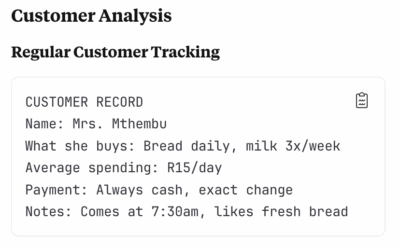
Regular Customer Tracking
—
CUSTOMER RECORD
Name: Mrs. Mthembu
What she buys: Bread daily, milk 3x/week
Average spending: R15/day
Payment: Always cash, exact change
Notes Comes at 730am, likes fresh bread
Customer Category Analysis
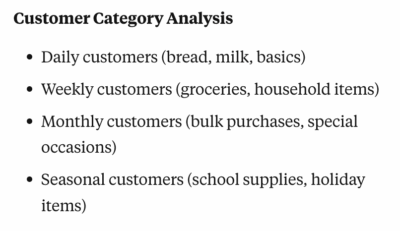
– Daily customers (bread, milk, basics)
– Weekly customers (groceries, household items)
– Monthly customers (bulk purchases, special occasions)
– Seasonal customers (school supplies, holiday items)
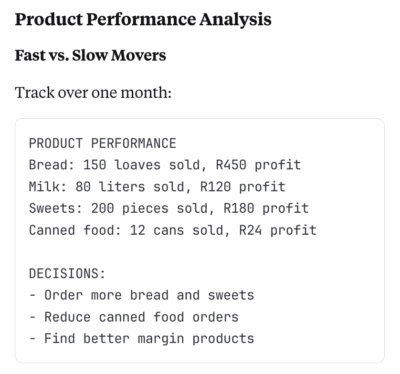
Product Performance Analysis
Fast vs. Slow Movers
Track over one month
—
PRODUCT PERFORMANCE
Bread 150 loaves sold, R450 profit
Milk 80 liters sold, R120 profit
Sweets 200 pieces sold, R180 profit
Canned food 12 cans sold, R24 profit
DECISIONS
– Order more bread and sweets
– Reduce canned food orders
– Find better margin products
—
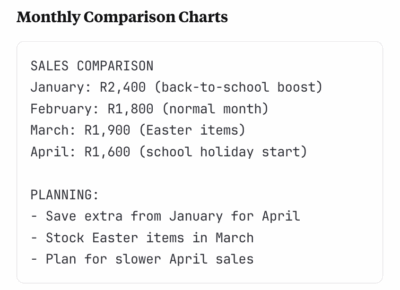
Seasonal Planning Records
Monthly Comparison Charts
—
SALES COMPARISON
January R2,400 (back-to-school boost)
February R1,800 (normal month)
March R1,900 (Easter items)
April R1,600 (school holiday start)
PLANNING
– Save extra from January for April
– Stock Easter items in March
– Plan for slower April sales
—
Creating Accountability Systems
Family Involvement
Daily Accountability
– Show spouse/parent daily profit figure
– Discuss any unusual expenses or sales
– Get advice on business decisions
– Build family understanding of business
Weekly Business Meetings
– Every Sunday review the week’s records
– Celebrate good days, analyze slow days
– Plan next week based on patterns
– Include family in business planning
Peer Accountability
Vendor Groups
– Meet weekly with other business owners
– Share general trends (not specific amounts)
– Learn from each other’s record-keeping methods
– Motivate each other to maintain records
Savings Group Integration
– Use records to plan savings contributions
– Show income verification for group loans
– Share business knowledge with group members
– Build community trust through transparency
Professional Support
When to Seek Help
– Business growing beyond simple records
– Tax registration becoming necessary
– Applying for formal business loans
– Considering partnership with others
What Records to Bring
– Daily record books for past 6 months
– Monthly summary sheets
– Bank statements if available
– List of assets and equipment
Protecting Your Records
Physical Protection
Weather Protection
– Keep book in plastic bag during rain
– Store in dry place overnight
– Make copies of important pages
– Use waterproof pen when possible
Theft Protection
– Don’t leave record book unattended
– Don’t record where money is hidden
– Use codes for sensitive information
– Keep backup copy at home
Information Security
What Not to Record
– Where cash is stored
– Bank account numbers or PINs
– Customer personal information
– Family financial details unrelated to business
Safe Information Sharing
– Only show records to trusted advisors
– Don’t share detailed information with competitors
– Protect customer privacy
– Keep family and business information separate
Building Record-Keeping Habits
The 21-Day Challenge
Week 1: Basic Habit Formation
– Focus only on recording sales and major expenses
– Don’t worry about perfect format
– Celebrate each day you remember to record
– Keep book and pen always visible
Week 2: Adding Detail
– Include smaller expenses
– Add time stamps to transactions
– Start noting customer patterns
– Begin daily total calculations
Week 3: Analysis and Planning
– Review each week’s patterns
– Make business decisions based on records
– Share insights with family
– Plan improvements for next month
Making It Sustainable
Habit Triggers
– Link recording to existing habits
– Record sale immediately when making change
– Review records while drinking morning tea
– Use closing time as trigger for daily totals
Reward Systems
– Celebrate weekly record completion
– Use good record-keeping to justify business investments
– Share success with family when records show growth
– Treat good records as business achievement
Case Studies - Records That Changed Businesses
Case Study 1: Nomsa’s Fruit Stand Transformation
Before Records
– Thought she was making R100+ profit daily
– Constantly short of money for restocking
– Couldn’t understand why business struggled
– Family doubted business was worthwhile
Record-Keeping Implementation
– Started simple notebook system
– Recorded every purchase and sale for one month
– Discovered real daily profit was only R45
– Found R1,200 monthly in forgotten small expenses
Results
– Raised prices by 15% based on true costs
– Eliminated unnecessary transport trips
– Increased actual profit to R85 per day
– Family now supports and helps with business
Case Study 2: Thabo’s Spaza Shop Growth
Starting Point
– Small spaza shop serving neighborhood
– Informal record-keeping (mental notes)
– Wanted to expand but banks required proof of income
– Couldn’t qualify for business loan
Record System
– Implemented daily sales tracking
– Separated personal and business expenses clearly
– Created monthly summaries for bank
– Tracked customer patterns and preferences
Business Growth
– Secured R10,000 microloan based on records
– Used loan to stock higher-margin items
– Increased monthly profit from R2,000 to R4,500
– Planning to open second location
Case Study 3: Beauty’s Catering Success
Challenge
– Home-based catering business
– Irregular income made budgeting difficult
– Wanted to hire assistant but unsure if affordable
– Family pressure to get “real job”
Record-Keeping Solution
– Tracked every catering job separately
– Calculated profit per event and per hour worked
– Created monthly income projections
– Documented business growth over time
Outcomes
– Proved business earned more than potential employment
– Hired part-time assistant based on profit calculations
– Family now fully supportive of business
– Expanding into wedding catering market
x

Contact With Us!
2220 Plymouth Rd #302, Hopkins, Minnesota(MN), 55305
Call us: (234) 109-6666
Mon – Sat: 8.00am – 18.00pm / Holiday : Closed