
By the end of this lesson, you will be able to:
– Set profitable prices that cover all costs and provide fair profit
– Balance competitive pricing with value delivery to customers
– Adjust pricing based on the value you provide compared to competitors
– Understand the difference between making money and making profit
– Use pricing strategies that work in the South African small business environment
Every day, South African small business owners face the same challenge: price too high and customers walk away, price too low and you work for nothing.
Whether you’re selling vegetables from a trolley, cutting hair in your backyard, or running a spaza shop, getting pricing right is the difference between surviving and thriving.
This lesson will show you how to find that sweet spot where customers are happy to pay and you make enough profit to feed your family and grow your business. It’s not about being the cheapest – it’s about being the best value.
The video teaches a crucial truth. Pricing isn’t just about competition or just about costs – it’s about finding the balance between what customers will pay and what you need to earn. Too many small business owners focus only on one side of this equation and end up either losing customers or working for free.
The video emphasizes that people pay for value, not just products. If you’re cleaner, faster, more reliable, or more convenient than your competitors, you can charge more – but only if customers can see and feel that difference.
The video’s final point is critical. Having money in your pocket at the end of the day doesn’t mean you made profit. Real profit only happens after you’ve covered all your costs, including the value of your time.
– Price-sensitive due to economic constraints
– Value convenience and relationships over luxury
– Often buy in small quantities due to cash flow
– Loyal to vendors who treat them fairly
– Many vendors selling similar products
– Easy entry for new competitors
– Location often more important than price alone
– Quality differences can be hard to see
– Monthly income cycles affect spending patterns
– Seasonal employment creates irregular demand
– Economic stress makes every rand important
– Limited access to credit affects purchase decisions
– Community support affects pricing tolerance
– Helping neighbors during tough times
– Building long-term relationships over short-term profit
– Reputation more important than individual transactions
– Many customers expect to negotiate prices
– Fixed pricing can seem unfriendly
– Small discounts show goodwill
– Bulk buying often expected to get better prices
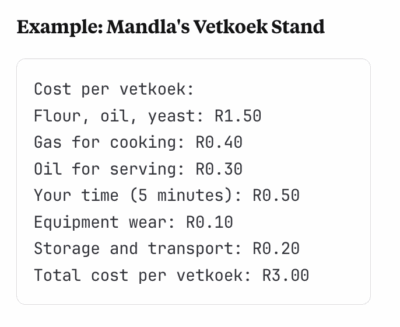
Before setting any price, you must know exactly what it costs to provide your product or service
Direct Costs
– What you pay for the product
– Transport to get stock
– Packaging and storage Spoilage and waste allowance
Indirect Costs
– Rent and utilities
– Equipment wear and tear
– Your time and labor
– Business licenses and permits

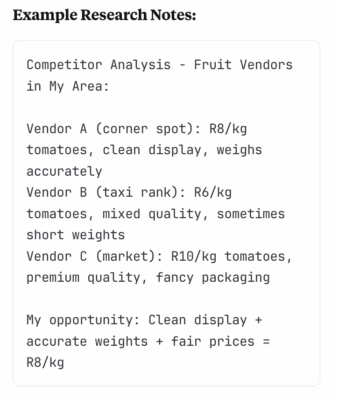
What to Observe
– Prices charged by similar vendors
– Quality levels they provide
– Services they include or exclude
– Customer satisfaction levels
– Busy times and quiet times
How to Research
– Visit competitors as a customer
– Ask family/friends about their experiences
– Observe from a distance during busy periods
– Note which vendors have loyal customers vs. one-time buyers

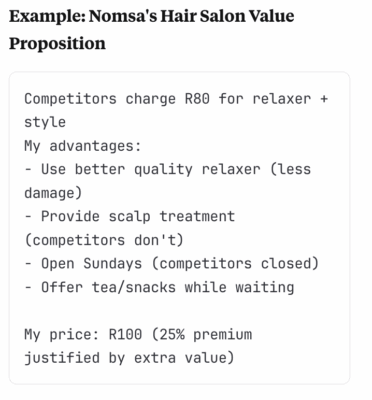
What makes you different from competitors
Service Quality
– Cleaner preparation area
– More accurate measurements
– Fresher products
– Better customer service
Convenience Factors
– Better location or parking
– Faster service
– Longer opening hours
– Home delivery options
Relationship Benefits
– Know customers by name
– Remember their preferences
– Flexible payment options
– Community involvement

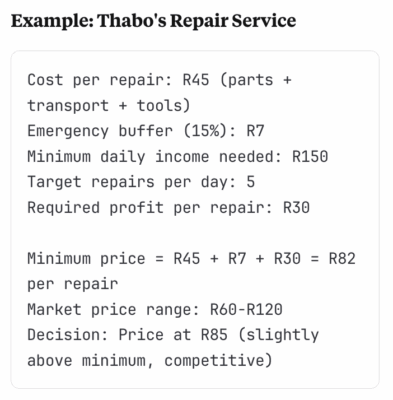
– Where Total Costs = All expenses to deliver product/service
– Emergency Buffer = 10-15% for unexpected costs
– Survival Profit = Minimum you need to live and grow business

– Price at the top of local market range
– Justify with superior quality or service
– Focus on building premium reputation
– Accept lower volume for higher margins
When to use: When you can clearly demonstrate superior value
Example: Premium fruit vendor with organic products and attractive display
– Price in middle of market range
– Offer good quality at fair prices
– Build customer loyalty through consistency
– Focus on repeat customers
When to use: When quality is good but not exceptional
Example: Reliable vegetable vendor with consistent quality and fair weights
– Price at bottom of market range
– Make profit through high volume sales
– Keep costs very low
– Focus on speed and efficiency
When to use: When you can achieve significantly lower costs than competitors
Example: Bulk snack vendor with supplier connections enabling lower costs
Product : Bread
Supermarket price – R12
My price – R14 (17% premium)
Justification
– Save customer transport costs
– Open when supermarket closed
– Credit available for regular customers
– No queues or parking hassles
Single items at competitive prices
1 packet soup – R8
1 cool drink – R10
Bulk discounts
3 packets soup – R22 (save R2)
6 cool drinks – R55 (save R5)
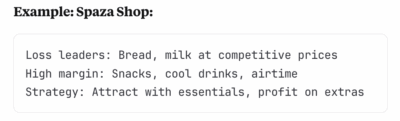
– Loss leaders (break-even prices) to attract customers
– High-margin add-ons to make profit
– Cross-selling complementary products
Example
Loss leaders: Bread at cost (R12) – attracts customers
Profit makers: Milk R18 (cost R14), Cool drinks R12 (cost R8)
Result: Customer buys bread + milk + cool drink = R42 (R8 profit)
Calculate hourly rate needed:
Monthly expenses R3,000
Hours worked per month 120
Minimum hourly rate R25
Service pricing
– Hair wash and set (2 hours) R60
– Full relaxer and style (4 hours) R120
– Braids (6 hours) R180
Price based on customer benefit, not just time
Wedding hair and makeup
– My time 4 hours
– Customer value Looking perfect on special day
– Market rate for weddings R400-R800
– My price R600 (premium for wedding expertise)
Bundle services for better value
Individual services
– Wash R15
– Cut R25
– Style R20
Total R60
Package price R50 (save R10, encourage full service)
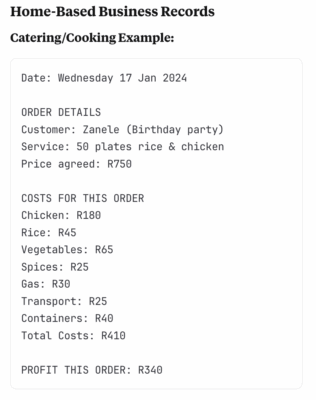
ORDER DETAILS
Customer Zanele (Birthday party)
Service 50 plates rice & chicken
Price agreed R750
COSTS FOR THIS ORDER
Chicken – R180
Rice – R45
Vegetables R65
Spices R25
Gas R30
Transport R25
Containers R40
Total Costs R410
PROFIT THIS ORDER R340

In South African Context
When to use R9 pricing
When to use round numbers
Show higher prices first to make your price seem reasonable:
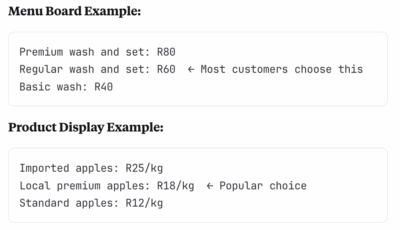
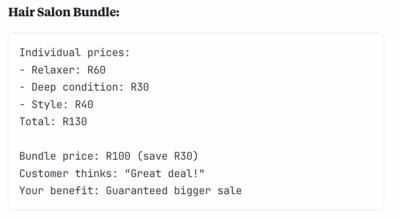
Make customers feel they’re getting a deal:
Month-End Strategy (25th-5th)
– Maintain regular prices
– Offer premium options
– Introduce new higher-margin products
– Focus on quality and service
Mid-Month Strategy (6th-24th)
– Consider small discounts for regulars
– Promote bulk buying options
– Focus on essential items
– Offer credit to trusted customers
School Holiday Pricing
During School Terms
– Premium prices for school-related items
– Convenience pricing for busy parents
– Time-sensitive service premiums
School Holidays
– Competitive pricing on children’s items
– Family package deals
– Volume discounts for celebrations
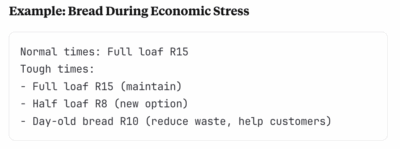
Economic Stress Pricing
During Tough Times
– Smaller portion sizes at lower prices
– Payment plan options
– Community support pricing
– Focus on absolute essentials
Wrong: “I use expensive oil for cooking”
Right: “I use fresh oil daily so your food tastes better and is healthier”
Wrong: “My relaxer costs more”
Right: “This relaxer is gentler and makes your hair softer with less damage”
Wrong: “I have to charge for transport”
Right: “I deliver to your door so you don’t waste taxi fare”
Help customers understand your costs and quality
Fruit Vendor Example
“I go to the market at 4am every day to choose the freshest fruit. Others buy yesterday’s leftovers. That’s why mine costs a little more but lasts longer in your fridge.”
Show value compared to alternatives
Spaza Shop Example
“Yes, I’m R2 more than the supermarket, but think about it taxi fare R24, your time 2 hours, parking R10. You actually save money shopping here.”
Stand behind your pricing with guarantees
Service Business Example
“If you’re not completely happy with the service, I’ll redo it free or give you your money back.”
Response Strategy
1. Acknowledge their concern
2. Explain your value
3. Offer alternatives
Example Response
“I understand price is important. Let me show you why my vegetables are worth it . they’re fresher, so they last longer. But if budget is tight today, these slightly smaller ones are R2 less per kg.”
Response Strategy
1. Don’t criticize competitors
2. Highlight your unique benefits
3. Let customer choose based on value
Example Response
“Yes, everyone has different prices. Here you get accurate weights, fresh products daily, and I’m here 6 days a week if there’s any problem. What’s most important to you?”
Response Strategy
1. Show empathy
2. Offer solutions
3. Maintain relationship
Example Response
“I understand. Unfortunately, we all have those days. For regular customers like you, you can pay me tomorrow. Or would you like a smaller portion today?”
When to Negotiate
When to Stand Firm
The Compromise
“I can’t go lower on the price, but I can give you extra quantity”
The Package Deal
“Buy these two items together and I’ll give you R5 off the total”
The Loyalty Discount
“For regular customers like you, next time I’ll remember this discount”
– Consistent fair pricing builds loyalty
– Occasional small discounts show appreciation
– Remember their preferences and adjust accordingly
– Credit options for trusted customers
– Volume discounts that still maintain profit
– Special wholesale arrangements
– Priority service and ordering
– Flexible payment terms
– Standard market pricing
– Focus on demonstrating value
– Excellent first impression service
– Incentives to become regular customers
– Community members in crisis compassionate pricing
– Celebrations and events premium service pricing
– Children friendly pricing with portion control
– Elderly customers patient service, fair pricing
– Check online prices for reference
– Compare with local competitors
– Track price changes over time
– Research new product pricing
– Cost + profit calculations on the spot
– Bulk discount calculations
– Tip calculations for services
– Currency conversions if needed
– Send updated price lists to regular customers
– Share special offers and promotions
– Confirm pricing for custom orders
– Build customer database for targeted offers
– Explain price changes professionally
– Gather feedback on pricing
– Handle price objections via message
– Build relationships that support pricing
“Everyone else charges R10, so I charge R10 too”
– Your costs might be different
– Your service level might be different
– Your location advantages might justify higher prices
– You might be losing money without knowing it
– Calculate your own costs first
– Use competitor prices as reference, not rules
– Find ways to add value that justify your pricing
– Test different price points carefully
Always being the cheapest option in the market
– Leads to price wars that hurt everyone
– Customers may question quality
– No room for unexpected cost increases
– Difficult to invest in business improvements
– Compete on value, not just price
– Find unique selling points
– Build customer relationships
– Focus on service excellence
Keeping the same prices regardless of economic conditions
– Miss opportunities during good times
– Lose customers during tough times
– Don’t adapt to changing customer needs
– Can’t respond to cost changes
– Monitor local economic conditions
– Adjust pricing strategies seasonally
– Offer different options for different budgets
– Maintain flexibility while protecting profitability
Setting prices based on emotions rather than business logic
– “I need money” leads to overpricing
– “I feel sorry for customers” leads to underpricing
– Guilt about making profit hurts business sustainability
– Personal financial stress affects business decisions
– Base pricing on costs and market reality
– Separate personal financial needs from business pricing
– Understand that fair profit is good for everyone
– Use records and data, not emotions
– You provide products/services people need
– You create jobs and contribute to community
– You take risks and deserve fair reward
– Your success helps family and community
– Practice explaining your prices
– Focus on benefits you provide
– Stand behind your pricing decisions
– Don’t apologize for fair prices
Common Fears
– Customers will stop buying
– Competitors will steal customers
– People will think you’re greedy
– Business will fail due to high prices
Reality Checks
– Good customers pay for good value
– There’s room for different price levels in market
– Fair profit ensures business survival
– Underpricing kills more businesses than overpricing
Practice Opportunities
– Role-play price objections with family
– Practice explaining value propositions
– Test different approaches with friendly customers
– Learn from successful local businesses
Continuous Improvement
– Track which pricing strategies work
– Ask customers for feedback
– Monitor competitor changes
– Adjust based on results, not fears
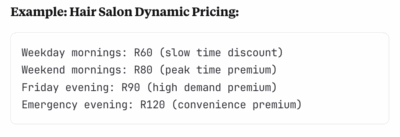
Time-Based Pricing
– Higher prices during peak demand times
– Lower prices during slow periods
– Premium pricing for urgent services
– Off-peak discounts to balance demand

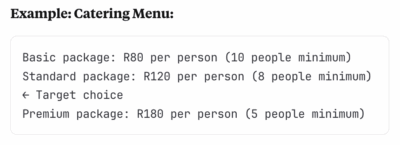
Make your preferred option look more attractive.
Most customers choose Standard because it seems like good value compared to Premium.

Use low-margin items to attract customers for high-margin sales

– Don’t exploit emergencies for excessive profit
– Maintain consistent pricing for similar customers
– Honor advertised prices
– Don’t mislead about quality or quantity
– Consider impact on community affordability
– Support community during crisis periods
– Don’t engage in price fixing with competitors
– Contribute fairly to local economy
– Display prices clearly where required
– Honor advertised prices
– Don’t engage in false advertising
– Comply with consumer protection laws
– Be transparent about all costs
– Explain any additional charges upfront
– Handle complaints fairly and quickly
– Maintain good reputation through fair dealing
– Profit per transaction
– Daily/weekly/monthly profit totals
– Customer lifetime value
– Average transaction size
– Customer retention rate
– New customer acquisition
– Customer complaints about pricing
– Customer referrals and recommendations
– Market share in your area
– Customer switching to/from competitors
– Competitive response to your pricing
– Your positioning in local market
– Review profit margins by product/service
– Analyze customer feedback on pricing
– Compare with competitor pricing changes
– Assess impact of economic conditions
– Evaluate overall pricing strategy effectiveness
– Consider seasonal adjustments needed
– Plan for upcoming busy/slow periods
– Adjust pricing structure based on learning
– Set pricing goals for coming year
– Plan for known cost increases
– Develop new pricing strategies
– Train family/staff on pricing approaches
– Trying to compete by being the cheapest in the area
– Working 12 hours daily but barely breaking even
– Customers complained about poor quality
– Considering closing the business
– Calculated true costs including his labor
– Researched what customers valued most
– Focused on convenience and service quality
– Raised prices 15% but improved service significantly
– Longer opening hours (6am-9pm)
– Credit for regular customers
– Home delivery for R5 fee
– Better quality products, fresher stock
– Monthly profit increased from R800 to R2,400
– Customer complaints decreased dramatically
– Built loyal customer base of 50+ regular customers
– Expanded to second location based on success
– Four other fruit vendors within 200 meters
– All selling similar products at similar prices
– Struggling to differentiate and make adequate profit
– Customers seemed to buy randomly from whoever was closest
– Invested in better display setup and cleanliness
– Started going to market at 4am for freshest selection
– Learned about fruit quality and educated customers
– Raised prices 20% above local competition
– Showed customers how to identify quality fruit
– Explained why her fruit lasted longer
– Offered fruit replacement guarantee
– Built personal relationships with regular customers
– Initially lost some price-sensitive customers
– Gained customers willing to pay for quality
– Higher profit per sale compensated for lower volume
– Built reputation as the “quality fruit lady”
– Now training other family members in the business
– Charging R50 per repair (copying competitors)
– Working hard but couldn’t afford tools and parts
– Customers expected miracle repairs for low prices
– Business couldn’t grow or improve
– Calculated true costs R35 per repair average
– Researched what customers really valued
– Developed pricing tiers based on service level
– Focused on reliability and guarantees
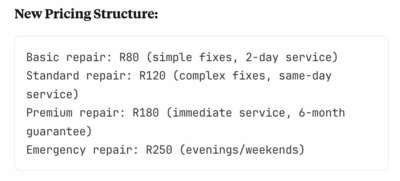
– Most customers chose Standard level
– Premium and Emergency services provided high margins
– Could afford better tools and genuine parts
– Built reputation for reliable, guaranteed work
– Expanded to training other technicians

– Calculate your true costs for main products/services
– Include ALL expenses, including your time
– Determine your minimum viable prices
– Compare with current prices you charge
– Visit or research 3-5 competitors
– Note their prices, quality, and service levels
– Identify gaps where you could add value
– Assess your competitive positioning
– List what makes you different/better
– Practice explaining your value to customers
– Develop responses to common price objections
– Test new value messages with friendly customers
– Adjust prices based on your analysis
– Communicate changes to regular customers
– Monitor customer reactions and adjust approach
– Track results and customer feedback
Remember Good pricing is a balance between covering costs, providing value, and staying competitive. Don’t be afraid to charge fair prices. Your business sustainability depends on making adequate profit.
Focus on delivering excellent value and communicate that value clearly to customers.
Congratulations! You’ve now completed the foundational lessons on business financial management.
You understand costs, stock management, record keeping, and pricing strategy.
These four elements work together to create a sustainable, profitable business.
– Use your cost knowledge to set minimum viable prices
– Use stock management to optimize profit margins
– Use record keeping to track pricing success
– Use pricing strategy to turn knowledge into profit
1- Implement the complete system costs + stock + records + pricing
2- Review and adjust weekly based on results
3- Build confidence in your pricing through value delivery
4- Share knowledge with other business owners in your community
– Master these basics before adding complexity
– Build systems that work reliably every day
– Use success to fund business growth and improvement
– Develop expertise that makes you indispensable to customers
– Model good business practices for others
– Share knowledge to lift up other entrepreneurs
– Contribute to local economic development
– Build reputation as serious, professional business owner
Your pricing strategy is the culmination of all your business knowledge. Price with confidence, deliver exceptional value, and watch your business transform from survival to success.
2220 Plymouth Rd #302, Hopkins, Minnesota(MN), 55305
Call us: (234) 109-6666
Mon – Sat: 8.00am – 18.00pm / Holiday : Closed