

In South Africa, cash flow challenges are particularly acute for small businesses due to several unique factors:
– Extended payment terms: Many corporate clients expect 30-60 day payment terms, while your suppliers often require immediate payment
– Economic volatility: Rand fluctuations and inflation affect purchasing power and costs
– Seasonal business patterns: Tourism, agriculture, and retail sectors experience significant seasonal variations
– Load shedding impact: Power cuts affect productivity and cash generation cycles
– High unemployment: Affects customer spending patterns and payment reliability
Many South African entrepreneurs confuse sales with cash. You might have R100,000 in outstanding invoices (profit on paper), but only R5,000 in your bank account. This is the cash flow trap that kills 60% of small businesses within their first three years.
Sipho’s electrical contracting business wins a R500,000 government tender. On paper, his profit margin is 25% (R125,000 profit). However:
– Materials cost R300,000 (paid upfront to suppliers)
– Labour costs R75,000 (paid weekly)
– Government payment: 90 days after completion
– Result: Despite being “profitable,” Sipho runs out of cash and can’t pay his team
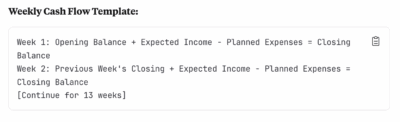
Create a weekly cash flow forecast that looks 13 weeks ahead. This gives you enough runway to spot problems and take action.
Understand how long it takes to convert your investment into cash:
Formula: Days to collect payment + Days inventory sits – Days you can delay supplier payments
Example for a small retailer:
– Buy inventory: Day 0 (cash out)
– Sell inventory: Day 45 (still no cash in)
– Customer pays: Day 75 (cash finally comes in)
– Cash conversion cycle: 75 days of cash tied up
Red Flags to Watch:
– Taking longer to pay suppliers
– Increasing reliance on overdraft facilities
– Customers asking for extended payment terms
– Inventory levels growing faster than sales
– Personal funds being used for business expenses
– Staff asking about delayed salaries

– Never rely on one large government contract – spread risk across multiple smaller clients
– Factor in corruption delays – government payments often take 120+ days instead of the promised 30
– Build buffer clauses – include inflation adjustments in contracts longer than 6 months
– Use invoice financing – companies like Bridgement or Retail Capital can advance 80% of government invoices
– Energy contingency fund – set aside 3-5% of revenue for generator fuel/backup power
– Adjust operating hours – align production with power availability schedules
– Customer communication – inform clients about potential delivery delays due to power cuts
– Alternative work arrangements – have low-power tasks ready during outages
– EFT payments: Push customers toward electronic payments (faster than cheques)
– Snapscan/Zapper: For retail businesses, reduce cash handling and bank deposit delays
– Accounting software: Use Pastel, Sage, or cloud-based solutions like Xero for real-time visibility
– Automated reminders: Set up systems to chase overdue payments automatically
1. Payment Terms Strategy
2. Invoice Management
3. Diversified Revenue Streams
1. Supplier Relationship Management
2. Inventory Optimization
3. Operating Expense Management
Immediate Actions (Days 1-7):
Short-term Stabilization (Weeks 2-4):
Medium-term Recovery (Months 2-3):
Traditional Options:
Alternative Funding:
Minimum reserve: 3 months of fixed expenses Optimal reserve: 6 months of fixed expenses Growth buffer: Additional 20% for expansion opportunities
Daily Monitoring:
Weekly Review:
Monthly Analysis:
Create a simple dashboard showing:
Calculate current cash conversion cycle
Create 13-week cash flow forecast
List all outstanding debtors and creditors
Identify seasonal patterns in business
Send overdue payment reminders
Negotiate payment terms with top 3 suppliers
Set up automated invoicing system
Open emergency credit line
Create cash flow monitoring dashboard
Establish weekly cash flow review meetings
Train staff on cash handling procedures
Set up customer credit checks
Develop cash reserve building plan
Create crisis cash flow procedures
Review and adjust pricing for cash flow impact
Plan for seasonal cash flow variations
Remember: In South Africa’s challenging economic environment, cash flow management isn’t just about profit – it’s about survival. Your business might be profitable on paper, but without cash in the bank, you can’t pay rent, buy stock, or take care of your family. Master cash flow, and you master your business destiny.
2220 Plymouth Rd #302, Hopkins, Minnesota(MN), 55305
Call us: (234) 109-6666
Mon – Sat: 8.00am – 18.00pm / Holiday : Closed